
Difference Between RYA and ASA Marine Qualifications – Everything You Need To Know
Both the RYA (Royal Yachting Association) and ASA (American Sailing Association) offer structured sailing qualifications, from beginner level through to advanced offshore skippering. On the surface they can look similar, but they differ in training structure, recognitions, and especially in how useful they are for commercial work.
The Difference Between RYA and ASA
The RYA is the UK governing body for small craft qualifications, and can progress toward RYA/MCA Certificates of Competence used for commercial work.
The ASA route is a USA standards-based certification system delivered through affiliated schools and instructors, with eight main levels plus additional specialist endorsements.
In simple terms, the RYA route is often the stronger choice for sailors who want broad recognition in the UK and Europe, or who may want a route into commercially endorsed qualifications. ASA is often an excellent fit for sailors based in North America who want a flexible, modular recreational pathway with strong charter-focused courses.
RYA – Royal Yachting Association
- UK governing body for sail
- Widely recognised, especially in Europe
- Linked to the UK’s maritime authority, MCA
- Recreational courses can be commercially endorsed via the MCA
ASA – American Sailing Association
- USA wide body
- Widely recognised within North America
- Common requirement for chartering in the USA
- Courses are run internally and assessed by each school
Pathways – Difference Between RYA and ASA
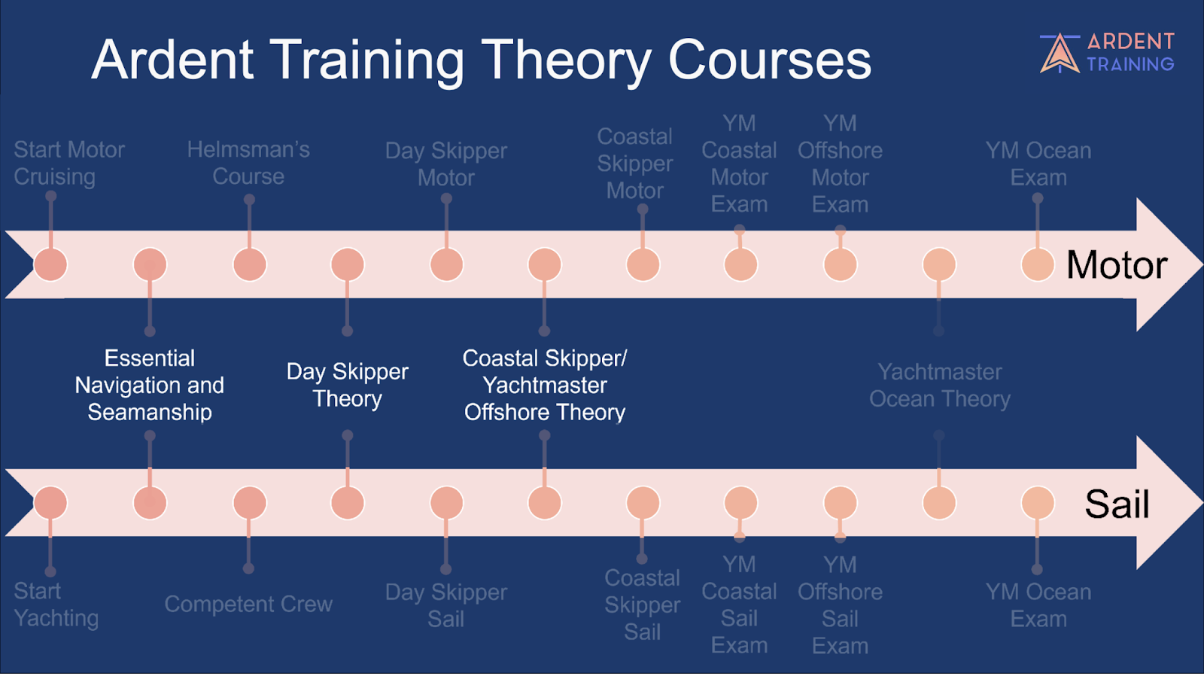
The RYA pathway is via their RYA cruising syllabus, which incorporates the following: Competent Crew / Helmsman → Day Skipper → Coastal Skipper → Yachtmaster Coastal / Offshore → Yachtmaster Ocean. These can be complimented by RYA theory courses.
ASA has a similar flow with more modular options from ASA 101 to ASA 120, where not every course is required, but they do follow a linear progression.
Difference Between RYA and ASA For Chartering A Vessel
The RYA cruising pathway typically starts with beginner practical courses such as Start Yachting or Competent Crew, then progresses through Day Skipper and Coastal Skipper, and finally onward toward Yachtmaster Coastal, Yachtmaster Offshore, and Yachtmaster Ocean.
The ASA pathway is more modular, with core certifications such as ASA 101, 103, 104, 105, 106, 107, and 108, plus specialist options including Cruising Catamaran, Docking, Weather, and Radar endorsements.
The RYA feels more like a traditional, clearly staged pathway. ASA gives you more flexibility to build skills through targeted add-ons depending on your sailing goals.
In much of Europe, charter companies often require an ICC (International Certificate of Competence).
With the RYA:
- RYA Day Skipper can be used to obtain an ICC (for eligible nationals)
- Widely accepted across Europe and the Mediterranean
- Some wider international recognition though less official.
With ASA:
- ASA 104 (Bareboat Cruising) is commonly accepted in the USA
- IPC (USA equivalent of ICC) can be obtained for evidence of competence for chartering
- Recognition outside North America is limited and varies by charter company
If chartering internationally, RYA qualifications tend to offer broader acceptance.
Chartering a Yacht: ICC vs IPC
For many sailors, the biggest practical difference appears when chartering abroad.
On the RYA side, the Day Skipper practical qualification can support an ICC application for eligible applicants, and the RYA generally recommends carrying an ICC as evidence of competence when cruising abroad. The ICC is written into most European countries law and so is indisputable. On the ASA side, American Sailing offers an IPC, which it says is designed mainly for Mediterranean charter companies as proof of bareboat competence, particularly because the United States is not an issuing state for the UNECE ICC. The IPC is accepted by some charter companies but is not necessarily written into law. In both systems, charter company policy still matters, so it is always worth checking directly with the operator before booking.
So, if your main goal is chartering in Europe or the Mediterranean, the RYA route often feels simpler and more direct. If you are based in the USA, ASA can still work well, but you should usually think in terms of ASA certifications plus an IPC where required.
Difference Between RYA and ASA Exams
Assessment is another genuine difference between the two systems.
RYA Certificates of Competence are exam-based, and RYA examinations are conducted independently of training centres. Yachtmaster Coastal and Yachtmaster Offshore exams are arranged through training centres but examined by RYA-provided examiners. ASA certifications, by contrast, are awarded directly through affiliated schools and instructors against ASA standards.
That does not make one system “good” and the other “bad”, but it does mean the RYA route, particularly at Yachtmaster level, carries a more formal external examination structure. That is one reason it is often seen as the stronger professional pathway.
Key differences:
- RYA Yachtmaster exams are externally examined
- Structured theoretical assessments support practical training
- MCA commercial endorsement is available for all skippering qualifications

Working Commercially: The Biggest Difference
This is where the gap often becomes clearest.
An RYA Yachtmaster Offshore can be commercially endorsed through the MCA. This allows you to:
- Work on UK-flagged vessels (up to 200GT in certain roles)
- Skipper commercially in many international settings
- Enter the superyacht and Mediterranean charter industries
An RYA/MCA Yachtmaster is widely regarded as the “gold standard” in the European charter market.
- ASA qualifications are primarily recreational courses,
- Not typically used for commercial employment
If your goal is:
- Superyacht crew work
- Charter skipper roles
- Commercial maritime employment
The RYA pathway is generally the stronger and more direct option.
Which Route Should You Choose?
Choose the RYA route if you want:
- a stronger pathway for UK and European chartering
- an ICC route for eligible applicants
- progression toward commercially endorsed qualifications
- an exam-based structure with strong external moderation at Yachtmaster level
Choose the ASA route if you want:
- a flexible modular certification pathway
- training mainly geared around recreational sailing and chartering
- a strong North American school network
- specialist options such as Bareboat Cruising and Cruising Catamaran certifications
RYA Theory Courses
One of the strengths of the RYA system is how closely theory and practical sailing support one another. For students aiming at Day Skipper, Coastal Skipper, or Yachtmaster level, good theory preparation often makes the practical stage far more useful and far less stressful.
At Ardent Training, we specialise in delivering RYA theory courses online, including:
- RYA Essential Navigation and Seamanship
- RYA Day Skipper
- RYA Fast Track to Yachtmaster
- RYA Coastal Skipper and Yachtmaster
Our courses include:
- Video and text-based lessons
- 1:1 instructor support (7 days a week)
- Downloadable resources
- Student discussion forums
- Live Q&A sessions with instructors and guest speakers
Final Thoughts
Both RYA and ASA can make you a safer, more confident sailor. But they are not identical routes. If you want a flexible recreational certification pathway, especially in North America, ASA is a strong option. If you want broader alignment with commercial structures, or a qualification route that is particularly strong for Europe and professional progression, RYA usually has the edge.
To find out more about the RYA cruising scheme, explore our our guide here. For more information on the RYA Yachtmaster exams, read more here.