RYA Basic Sea Survival Certificate: A Practical Guide
RYA Basic Sea Survival is a one-day course covering the essential skills for emergencies at sea. It introduces lifejackets, liferafts, distress signalling, and the practical realities of looking after yourself and your crew while waiting for rescue.
You will hopefully never need to use these skills for real. But if you ever do, knowing what to expect and how to use your safety equipment can make an enormous difference.
At Ardent Training we focus on RYA navigation theory courses, and we’re often asked how Sea Survival fits in alongside the rest of the RYA scheme. This guide answers the most common questions in plain English.
RYA Basic Sea Survival at a glance
- One day, partly classroom and partly in a swimming pool
- Open to leisure sailors, motor boaters, racers and offshore crew
- A common requirement for the RYA commercial endorsement
- No prior boating experience required
- Most centres provide oilskins and a lifejacket for the pool session (worth checking when you book).
What is RYA Basic Sea Survival?
RYA Basic Sea Survival introduces survival techniques and safety equipment for anyone going to sea. It is designed to help you understand what to do in an emergency, how to use the equipment carried on board, and how to improve your chances of being found by the rescue services.
It is a practical and genuinely useful course for sailors, motor boaters, RIB users, offshore crew, racers, skippers, and anyone who spends time afloat.
Who can do RYA Basic Sea Survival?
Anyone with an interest in safety afloat. The RYA does not require any prior boating experience.
The course is suitable for complete beginners as well as experienced boaters who want to refresh their safety knowledge. You do not need to be a skipper or working towards a professional qualification to benefit from it.
It is especially useful if you are:
- Going offshore
- Joining longer passages
- Racing
- Chartering
- Cruising with family or friends
- Working towards a commercial endorsement
- Taking on more responsibility as crew or skipper
Although the RYA does not publish a national minimum age, individual training centres often set their own age limit for the pool session, so check before booking.
If you are not a confident swimmer or have any medical concerns, speak to the training centre before booking. They will explain what is involved in the pool session and advise on suitability.
How long does RYA Basic Sea Survival take?
It is a one-day course, with a mix of classroom work and a swimming pool session. The exact timetable varies between centres but normally includes theory, discussion, demonstrations and practical exercises.
What does RYA Basic Sea Survival cover?
The RYA syllabus includes:
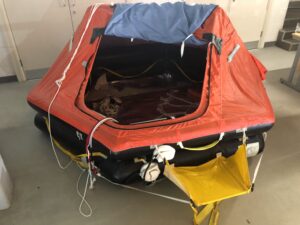
- Liferafts and the equipment they contain
- Survival techniques
- Lifejackets
- Medical aspects of sea survival
- Search and rescue techniques
The aim is not just to learn facts. The course is designed to help you think clearly in an emergency, understand what your equipment is for, and appreciate how difficult simple tasks can become when you are cold, wet, tired or under pressure.
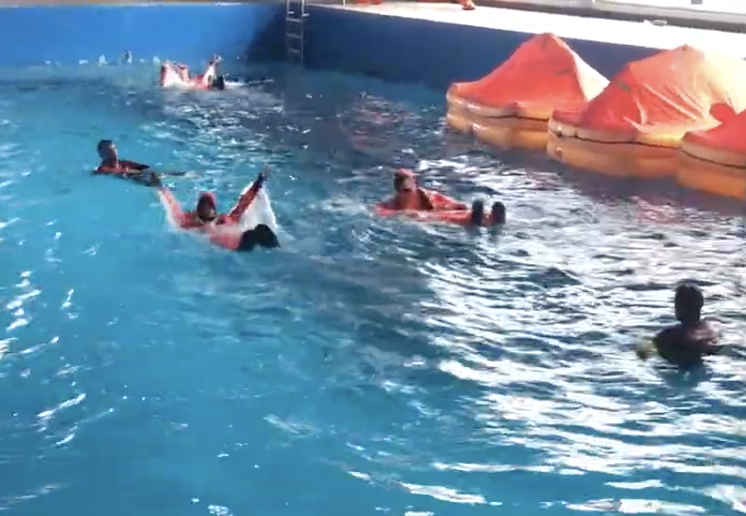
What happens in the swimming pool session?
Most students tell us the pool session is the highlight of the day.
You will usually wear wet weather gear and a lifejacket so that you experience how different it feels to move in the water dressed as you might be at sea.
Depending on the centre, the practical session may include:
- Entering the water safely
- Understanding how a lifejacket supports you
- Moving in the water while wearing wet weather gear
- Helping other people in the water
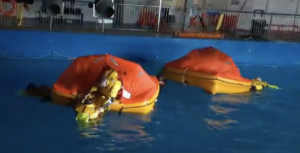
- Righting a liferaft
- Boarding a liferaft
- Assisting crew into a liferaft
- Managing yourself and others once inside
This part of the course is valuable because it gives you a far more realistic understanding of survival at sea. It is one thing to talk about boarding a liferaft in a classroom. It is another to try it in the water in bulky kit.
Do I need to be a strong swimmer?
You do not usually need to be a strong swimmer, but you do need to be willing to take part in a pool-based practical session.
The course is about survival, lifejackets, teamwork and emergency procedures rather than swimming technique. Every training centre has its own safety procedures, so always tell them in advance if you are not confident in water or if you have any medical concerns.
What should I bring?
Your training centre will send joining instructions before the course, and you should follow those carefully. As a general guide, you may need swimwear, a towel, a change of clothes, any required medication, and wet weather gear if your centre does not provide it. Lunch arrangements vary.
It is worth asking in advance whether oilskins, lifejackets and other pool kit are provided. Some centres include everything, others ask you to bring your own oilskins.
How much does RYA Basic Sea Survival cost?
Prices vary between centres, so compare what is included rather than simply choosing the cheapest option. Useful questions to ask:
- Is the RYA Sea Survival Handbook G43 included?
- Are wet weather gear and lifejackets provided?
- Is lunch or parking included?
- How much time is spent in the pool?
- How realistic is the practical session?
- Are there any extra charges?
The RYA Sea Survival Handbook G43 is the official text for the course and is often included by training centres. A well-run course with a strong practical session can be far more valuable than the cheapest option.
How is RYA Basic Sea Survival assessed?
There is no long written exam. The course is assessed through your participation in the practical sessions, including the pool work, alongside any short written assessment the centre uses on the day. (verify whether the current course still includes a short multiple choice paper)
The instructor will be looking for you to engage with the training and develop a working understanding of basic survival skills in the marine environment.
Does the certificate expire?
The RYA Basic Sea Survival certificate does not have a formal expiry in the same way as STCW Personal Survival Techniques, which typically requires periodic refresher training. Even so, it is good practice to refresh your knowledge regularly and review the safety equipment on your own boat each season.
Is RYA Basic Sea Survival needed for a commercial endorsement?
Often, yes. For a standard RYA commercial endorsement application the RYA lists a copy of your RYA Basic Sea Survival certificate, or an STCW Personal Survival Techniques certificate, as one of the required documents.
The RYA also lists other requirements, including:
- The Professional Practices and Responsibilities (PPR) certificate
- A valid RYA First Aid certificate or accepted equivalent
- A medical fitness certificate
- An RYA Marine Radio SRC Certificate or other acceptable GMDSS marine radio operator’s certificate
If you are taking the course for work, always check the current requirements for your exact qualification, flag state, employer and intended area of operation before booking.
RYA Basic Sea Survival vs STCW: which one do I need?
They are not the same.
RYA Basic Sea Survival is a one-day RYA course, focused on the essentials for small-craft sailors and motor boaters. STCW Personal Survival Techniques (PST) is the closer single-subject equivalent within the wider STCW Basic Safety Training package, which also includes Fire Prevention and Fire Fighting, Elementary First Aid, and Personal Safety and Social Responsibilities.
For many leisure sailors and some RYA commercial endorsement routes, RYA Basic Sea Survival may be all you need. Some employers, flag states or commercial roles may require STCW training instead.
The RYA notes that some employers or flag states may require STCW basic safety training, even where an RYA certificate of competence with a commercial endorsement fulfils legal requirements on British flagged vessels operating in the UK or many non-UK ports.
If you need the certificate for employment, check the exact requirement before booking.
Why is sea survival training worth doing?
At sea, emergencies can develop quickly. A fire, collision, sinking, man overboard, serious injury, or abandon ship situation puts pressure on everyone involved.
In those moments, it helps if you have already thought through the basics:
- Where is the safety equipment?
- How does the lifejacket work?
- How do we call for help?
- When should we abandon the vessel?
- How do we launch and board a liferaft?
- How do we stay together?
- How do we make ourselves easier to find?
Sea survival training gives you a framework for making better decisions when it matters most.
What should I do after RYA Basic Sea Survival?
A good habit is to review your boat’s safety equipment at the start of each season. Check where everything is stored, make sure the crew know how to find it, and talk through what you would do in an emergency.
A natural next step is the RYA Marine Radio SRC certificate. In an emergency, being able to send a clear distress call by VHF radio can be just as important as knowing how to use a liferaft. The SRC is also one of the standard requirements for the RYA commercial endorsement.
Other useful courses to consider include:
- RYA First Aid
- RYA Diesel Engine
- RYA Marine Radio SRC
- RYA Day Skipper Theory
- RYA Coastal Skipper / Yachtmaster Theory
- RYA Professional Practices and Responsibilities, if applying for a commercial endorsement
Final thoughts
RYA Basic Sea Survival is one of those courses you hope you never need, but will be very glad you completed if you ever do. It gives you a practical understanding of survival equipment, liferafts, lifejackets, emergency procedures and search and rescue, and it helps you feel calmer and more prepared if something goes wrong at sea.
If you go afloat, whether as skipper or crew, it is well worth considering.
If you are building your wider RYA knowledge, take a look at our online RYA theory courses at Ardent Training, including Day Skipper Theory and Coastal Skipper / Yachtmaster Theory. They pair naturally with Sea Survival and round out the core knowledge for safer, more confident time on the water.